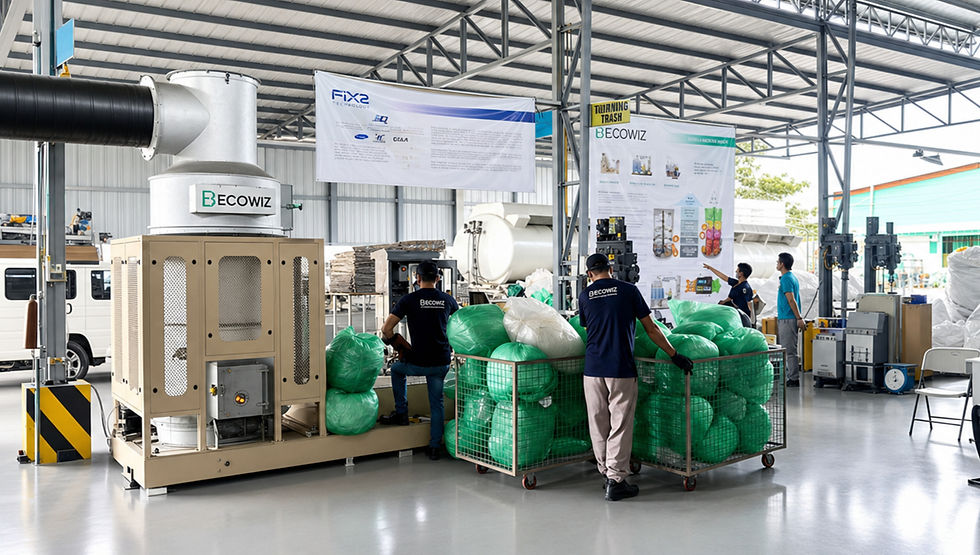
Resolving Philippine Landfill Overload with Waste-to-Oil

Updated: Jun 10
"Transitioning from traditional disposal to advanced thermal conversion allows Philippine municipalities and industries to transform plastic waste liabilities into secure, localized energy assets."

The Current Waste Management Challenges in the Philippines
Local Government Units (LGUs) and industrial manufacturing sectors across the Philippines face a critical saturation of local landfills and escalating logistical overhead. Traditional mechanical recycling systems are unable to efficiently process low-grade, contaminated, or mixed synthetic plastics, leaving communities with severe long-term disposal liabilities.
Transforming Waste Into Power
Innovative waste conversion systems divert waste from landfills while generating clean, usable energy.

Saturating Landfill Capacities:
Rapidly depleting space in municipal and provincial dumpsites.
Escalating Operational Costs:
Rising financial burdens associated with municipal waste hauling and tipping fees.
Regulatory Compliance Pressures:
Stringent national environmental mandates requiring higher waste-diversion rates from local governments.

Introduction to Advanced Waste-to-Oil Pyrolysis
Advanced Waste-to-Oil (WtO) technology resolves these modern bottlenecks through a continuous-operation, oxygen-free thermal decomposition framework. Rather than utilizing conventional incineration, this closed-loop pyrolysis system subjects synthetic resins to high-temperature processing to break down polymers at the molecular level, cleanly reforming them into industrial-grade fuel oil.
Feedstock Optimization:
Preparing and sorting synthetic polymer waste to maintain a stable, uniform input.
Molecular Decomposition:
Thermal processing inside a sealed, oxygen-free reactor to completely eliminate open combustion.
Resource Recovery:
Condensing vaporized hydrocarbons into a high-calorific recycled fuel oil, while capturing non-condensable gases to self-sustain the facility's heating burners.

Localized Economic and Environmental Benefits
Deploying decentralized Waste-to-Oil plants yields immediate operational advantages for Philippine communities and private stakeholders. This infrastructure optimizes regional resource loops, transforming a domestic waste problem into a consistent source of industrial energy.
90% Physical Volume Reduction:
Drastically shrinks municipal waste bulk, significantly extending the operational lifespan of localized infrastructure.
Energy Self-Sufficiency:
Reuses its own processed gases to power the internal system heaters, minimizing external utility demands and lowering overhead.
Certified Emission Safety:
Integrates advanced filtration arrays and scrubbers to safely meet national clean air standards with zero secondary pollution.
Secure Energy Supply:
Generates commercial-grade synthetic crude locally, shielding domestic shipping lines, heavy machinery, and industrial plants from global fuel market volatility.
Embracing advanced waste conversion is the next logical step for organizations looking to build resilient, self-sustaining operations. Implementing localized waste-to-oil facilities allows managers to permanently resolve their waste liabilities while securing a reliable, alternative energy source for the future.