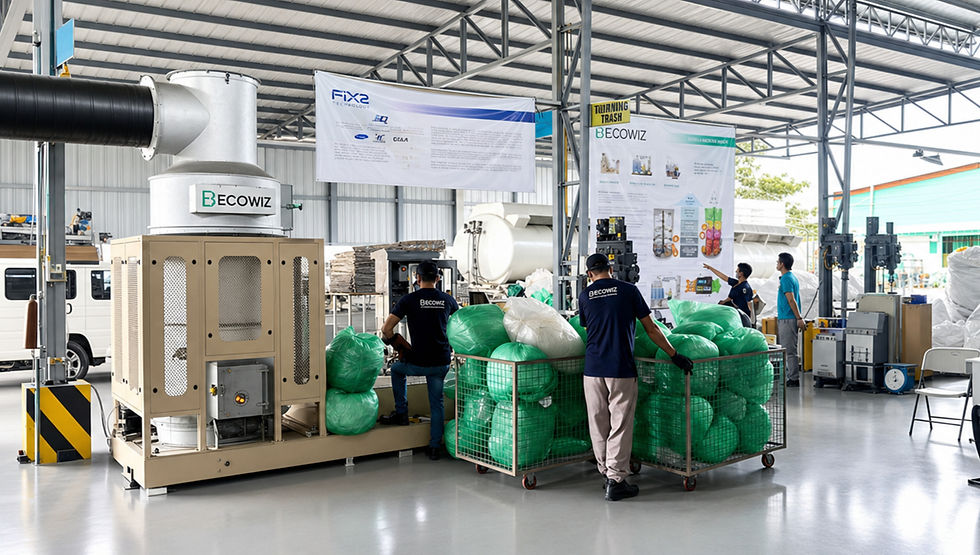
Waste-to-Oil Technology in Modern Waste Management
- FIXZ E3

- Jun 9
- 2 min read
Updated: Jun 10
"Smart waste management for a healthier environment."

As populations grow and industries expand, the amount of plastic waste generated each year continues to increase. While recycling remains an essential part of sustainable waste management, it cannot process every type of plastic. Contaminated, mixed, and low-value plastics often have limited recycling options, creating ongoing challenges for businesses, municipalities, and communities.
To help address this gap, innovative waste recovery technologies are becoming increasingly important. Among these solutions, Waste-to-Oil (WTO) technology offers a practical way to recover value from plastic waste while supporting more sustainable waste management practices.
Waste-to-Oil: Recovering Value from Plastic Waste
Waste-to-Oil systems use a process called pyrolysis—a thermal decomposition process that converts suitable plastic waste into valuable fuel products in an oxygen-limited environment.
Unlike conventional incineration, pyrolysis does not burn waste directly. Instead, plastic materials are heated under carefully controlled conditions, causing long-chain polymer molecules to break down into hydrocarbon vapors. These vapors are then cooled and condensed into reusable fuel oil, while non-condensable gases can be recovered and reused within the system to improve overall energy efficiency.
This process enables the recovery of energy from plastic waste that would otherwise be difficult to recycle or destined for disposal.
The Pyrolysis Process
1. Pre-processing Suitable plastic waste is sorted, prepared, and fed into the system.
2. Thermal Decomposition Plastic materials are heated in an oxygen-limited reactor, where they decompose into hydrocarbon vapor, process gas, and a small amount of solid carbon residue.
3. Oil Recovery The hydrocarbon vapor is cooled and condensed into reusable fuel oil.
4. Energy Recovery Non-condensable process gas can be reused as a fuel source within the system, reducing external energy requirements.
5. Emission Control Integrated environmental control systems help support efficient operation while meeting applicable environmental standards.
Why Waste-to-Oil Matters
As industries seek smarter waste management solutions, Waste-to-Oil provides an efficient way to recover value from plastic waste that cannot be conventionally recycled. By converting waste into fuel, organizations can reduce disposal costs while supporting circular economy initiatives.

A Technology Designed for tomorrow
The future of waste management depends on a balanced approach that combines waste reduction, recycling, and advanced resource recovery technologies. Waste-to-Oil is not intended to replace conventional recycling. Instead, it complements existing recycling systems by providing a solution for plastic materials that have limited or no viable recycling pathways.
At ECOWIZ, our Waste-to-Oil (W2W) Pyrolysis System is designed to convert suitable plastic and synthetic resin waste into valuable fuel through a continuous, energy-efficient process. By integrating advanced thermal decomposition technology with environmental control systems, the W2W solution helps industries recover resources while promoting cleaner and more responsible waste management.
As industries continue to pursue more sustainable operations and circular economy initiatives, Waste-to-Oil technology is becoming an increasingly important part of modern waste management. By recovering value from difficult-to-recycle plastics, it helps reduce waste, conserve resources, and support a cleaner, more resource-efficient future—where waste is recognized not simply as something to discard, but as a valuable resource with new potential.